guides
How Many Backlinks Do You Need to Rank? The Honest Answer (2026)
How many backlinks do you need to rank? The honest answer, the metric that actually matters, benchmarks by keyword difficulty, and how to get the links fast.
There's no fixed number of backlinks you need to rank — you need enough quality referring domains to match or beat the pages already ranking for your target keyword. For a low-competition keyword, that can be anywhere from zero to a handful of links. For a competitive keyword, it can mean dozens or even hundreds. What matters far more than the raw count is the number of unique websites linking to you (referring domains) and how relevant and authoritative those sites are.
In other words, the right question isn't "how many backlinks do I need?" — it's "how many quality referring domains do the pages I'm trying to outrank have, and can I earn more?" This guide shows you exactly how to find that number for any keyword, with rough benchmarks by difficulty and the fastest way to build the links you need.
The honest answer: it depends on your competition
Every SEO tool and guru wants to give you a magic number. The truth is that Google doesn't rank pages against a fixed backlink quota — it ranks them relative to each other. So the number of backlinks you need is entirely determined by two things:
How competitive your target keyword is. A niche, long-tail keyword needs far fewer links than a broad, high-value one.
How strong the pages currently ranking are. Your target is to have a comparable or stronger backlink profile than the pages in the top results.
This is why two keywords can require wildly different numbers. You might rank for a low-competition term with a brand-new page and no backlinks at all, while a competitive commercial term might need a page backed by 100+ referring domains. The number is always relative to the specific search result you're trying to break into.
Backlinks vs referring domains: the metric that actually matters
Here's the single most important distinction most people miss: referring domains matter more than total backlinks.
A backlink is any single link to your site.
A referring domain is a unique website linking to you.
If one website links to you 50 times, that's 50 backlinks but only one referring domain — and Google largely counts it as one vote of confidence. Ten links from ten different relevant, authoritative websites are worth far more than 500 links from a single site.
So when you assess "how many backlinks you need," measure referring domains, not raw backlink count. It's the metric that actually correlates with rankings, and it's the one you should benchmark against your competitors.
How to find the exact number you need
Instead of guessing, reverse-engineer it from the search results. Here's the method:
Search your target keyword on Google (in an incognito window).
Look at the pages ranking in the top 5–10. These are the pages you need to match or beat.
Check their referring domains using an SEO tool (Ahrefs, Moz, or similar). Look at how many unique websites link to each specific page (not just the whole domain).
Find the median. Ignore the one outlier with 5,000 links; look at what a typical top-10 page has.
Set your target above that. Aim to earn a comparable number of relevant referring domains, with equal or better quality.
This turns an unanswerable question into a concrete, page-by-page target. Do it for every keyword you seriously want to rank for — the number will be different each time, and that's exactly the point.
Rough benchmarks by keyword difficulty
These are directional starting points only — always verify against the actual pages ranking for your keyword, because competition varies enormously between niches. Referring domains here means unique linking websites to the page.
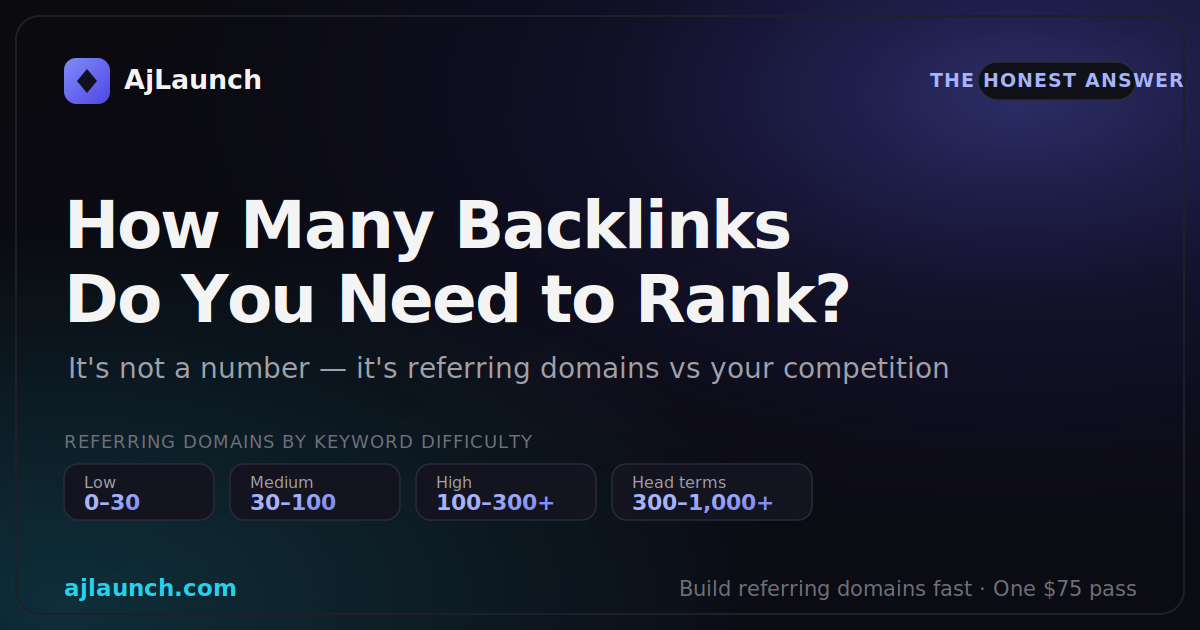
Keyword competition | Typical referring domains to rank | Example |
|---|---|---|
Very low (long-tail, niche) | 0–10 | "best directory submission tool for indie hackers" |
Low | 10–30 | "free directory submission sites" |
Medium | 30–100 | "link building for startups" |
High | 100–300+ | "best CRM software" |
Very high (head terms) | 300–1,000+ | "project management software" |
The pattern is clear: the more commercial and competitive the term, the more referring domains you'll need. This is also why targeting lower-competition keywords first is the smart play for a new site — you can rank with a handful of links while you build authority for the harder terms.
Why quality beats quantity every time
Ten great links will out-rank a thousand bad ones. When you evaluate a potential backlink, three factors decide its value:
Authority (domain rating). A link from a high-DR site passes far more ranking power than one from an unknown site.
Relevance. A link from a site in your niche is worth more than one from an unrelated topic. A backlink from a startup directory to a startup is a natural, relevant signal.
Placement and type. Editorial, in-content links carry more weight than footer or sidebar links. Dofollow links pass direct SEO value; nofollow links still drive traffic and a natural link profile.
This is why chasing a big number is a trap. A page with 20 relevant, high-authority referring domains routinely outranks one with 400 spammy ones — and the spammy profile can trigger penalties. Sort every link opportunity by domain rating and relevance, and ignore the counter.
How many backlinks per month is safe?
There's no exact "safe" number of backlinks per day or per month — what matters is that your link growth looks natural. A sudden spike of hundreds of low-quality links from nowhere is a classic spam signal; a steady stream of relevant, quality links is exactly what a growing, legitimate site looks like.
Practical guidance:
Focus on a steady, sustainable pace rather than hitting a monthly quota.
A new site earning a handful of quality referring domains a month is healthy and natural.
Avoid buying bulk links or blasting hundreds of directory links overnight — velocity spikes of low-quality links are what get sites into trouble, not the raw number itself.
Quality links can come fast and safely when they're genuinely relevant — for example, listing your startup across relevant, high-DR directories over a launch week is natural, because a new product legitimately gets discovered and listed in many places at once.
Can you rank with zero backlinks?
Yes — for low-competition, long-tail keywords, a well-optimized page with strong content can rank with few or no backlinks, especially if your site already has some authority. Google uses hundreds of ranking signals; backlinks are one of the strongest, but content relevance, search intent match, and user experience matter too.
That said, for anything commercial or competitive, backlinks are usually decisive. The realistic approach for a new site: target low-competition keywords you can rank for now with minimal links, while steadily building the referring domains you'll need for the harder terms later.
How to get the backlinks you need (fast)
Once you know your target number, you need an efficient way to earn relevant, high-DR links. For startups and SaaS, the fastest starting point is directory and launch-platform submissions — they're relevant, mostly free, get indexed quickly, and let you build a baseline of referring domains in a single sprint. From there, layer on the higher-effort tactics.
The full sequence is in our link building for startups playbook. To build a baseline of referring domains quickly, start with the ranked list of directory submission sites — or the free directory submission sites if you're on zero budget. New to the concept? See what is directory submission.
Common mistakes about backlink numbers
Chasing a total backlink count. Measure referring domains, not raw links.
Ignoring competition. The number you need is relative to the pages you're trying to outrank — there is no universal figure.
Prioritising quantity over quality. Twenty relevant, high-DR links beat hundreds of spammy ones.
Building links faster than is natural. Sudden spikes of low-quality links are the real risk.
Waiting to "have enough" before publishing. Publish, then earn links steadily — ranking is a process, not a one-time threshold.
Frequently asked questions
How many backlinks do I need to rank on the first page?
There's no fixed number — it depends on the keyword's competition. Check the referring domains of the pages currently ranking on page one for your keyword and aim to earn a comparable number of relevant, high-authority links. Low-competition terms may need only a handful; competitive terms can need 100 or more.
How many backlinks should a website have?
As many relevant, quality referring domains as it takes to compete for its target keywords — there's no ideal total. A small site targeting niche keywords may need a few dozen; a site competing for commercial head terms may need hundreds. Focus on referring domains and quality over any absolute number.
How many backlinks do I need for a new website?
Start by targeting low-competition, long-tail keywords that you can rank for with 0–10 relevant referring domains, and build from there. A baseline of listings from relevant, high-DR directories is a fast, safe way to earn your first referring domains.
How many backlinks per day or per month is safe?
There's no exact safe number — what matters is that growth looks natural. Focus on a steady, sustainable pace of quality links rather than a quota, and avoid sudden spikes of low-quality links, which are the real risk.
Do referring domains matter more than backlinks?
Yes. Referring domains (unique websites linking to you) correlate with rankings far better than total backlink count. Ten links from ten relevant, authoritative sites are worth more than hundreds from a single site.
Can I rank without any backlinks?
For low-competition, long-tail keywords, yes — strong, relevant content can rank with few or no backlinks. For competitive or commercial keywords, quality backlinks are usually necessary.
Build your referring domains the fast way
Whatever number you need, the fastest way to a baseline of relevant, high-DR referring domains is directory and launch submissions. Browse 300+ free directories — no signup — or unlock the full 3,427+ verified, DA-sorted catalog for a $75 one-time payment.
→ Start building backlinks · Read the link building playbook
Related articles
- How we score freshness in the directoryA transparent look at how AjLaunch thinks about recency, authority signals, and when a listing deserves a higher rank in your workflow.
- Premium backlink directory playbookA practical workflow for using AjLaunch Premium: filters, exports, and collaboration without losing governance.
Explore the backlink directory, browse SaaS directory hubs, or compare Premium plans.